


How the Plinko Game Works: Risk Tiers, RTP, and Bonus Value
Step into one of the most engaging plinko game experiences available online. Whether you are a first-time player or a seasoned casino enthusiast, this guide covers everything you need — from the basic rules to the specific numbers that define how the slot works, including RTP, multiplier values, and board configurations.
The following table summarizes the key facts about the game at a glance.
| Aspect | Details |
|---|---|
| 🌐 Official Website | plinkoapponline.com |
| 🎰 Game Type | Interactive Casino Game (Arcade / Crash style) |
| 🏢 Primary Developer | BGaming |
| 📊 RTP | 99% (BGaming) |
| 🏠 House Edge | ~1% |
| 💰 Bet Range | $0.10 – $100 per drop |
| 🎲 Risk Tiers | Low / Medium / High |
| 🔢 Row Configurations | 8, 12, or 16 rows |
| 🌐 Platforms | Stake, Roobet, BC.Game, TrustDice, Rollbit, and more |
| 🔮 Fairness | Provably fair (seed-based cryptographic verification) |
| 👍 Demo Mode | Available at most supported casinos |
How to Play Plinko gambling game in 4 Easy Steps
The rules are straightforward, but understanding the configuration options makes a real difference to your results. Here is a step-by-step breakdown of a standard round.
- Select Your Stake:
Choose your bet amount. Most implementations accept wagers from $0.10 to $100 per drop. The higher your stake, the larger the absolute payout when the chip lands in a high-multiplier slot.
- Choose Your Risk Level:
Set the game’s volatility to Low, Medium, or High. This setting directly controls the multiplier distribution across the board’s landing slots. Low risk produces frequent small wins; High risk concentrates payouts at the edges for rare but massive returns.
- Set the Row Count:
Select 8, 12, or 16 rows. More rows mean more pegs, a wider board, and more extreme outcomes — the chip has more opportunities to drift toward the high-multiplier edge slots. Fewer rows produce a tighter distribution around the center.
- Drop the Ball and Collect:
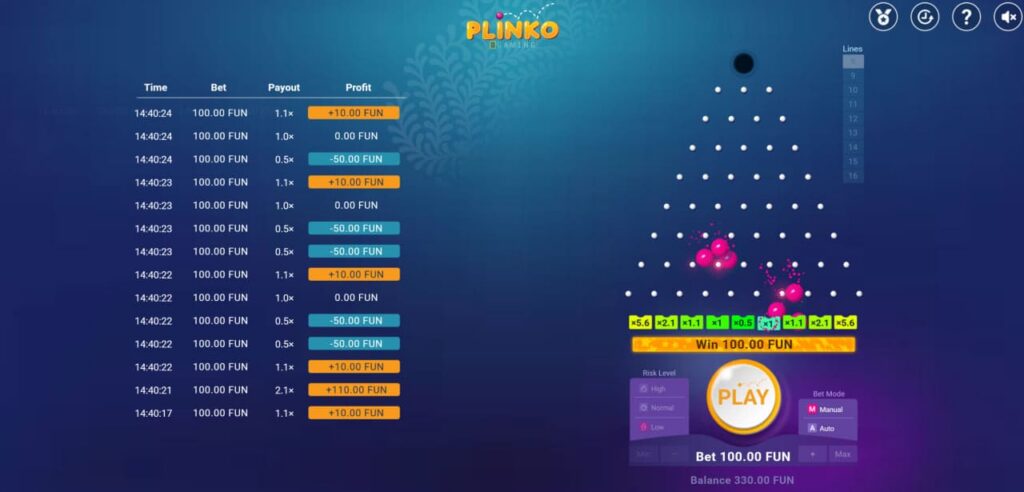
Click “Play” to release the chip. It bounces through the peg grid and lands in a numbered slot. Your payout equals your stake multiplied by that slot’s value. Winnings are credited instantly.
What Is Plinko and Why Is It So Popular?
The game’s mechanic originates from the Galton board — a scientific device that demonstrates how random events cluster around a bell curve. Casino developers adapted this into a digital format in the early 2010s, and it became a mainstream gambling product after high-profile streamers began broadcasting sessions on Twitch.
Roshtein typically plays at High risk / 16 rows with stakes of $10–$100 per drop — a configuration that maximizes visual drama but produces frequent below-stake results between edge hits. xQc’s viral sessions have predominantly used Medium risk, which balances the frequency of visible wins against the possibility of large multipliers. This streamer-driven visibility turned a niche casino format into a global phenomenon, but the configurations these players use reveal as much about variance as they do about entertainment value.
What keeps players coming back is the combination of simplicity and genuine suspense. Every drop is independent, every outcome is random, and the visual journey of the chip through the pegs creates a moment of anticipation that few other casino games can replicate. The game also benefits from extremely low friction — there are no complex rules to learn, no bonus rounds to trigger, and no waiting for other players. Each round takes seconds, which makes it easy to play in short bursts or extended sessions.
The following features explain why the slot has built such a broad audience across different player types:
- Adjustable stakes from $0.10 to $100 per drop
- Three risk tiers and three row configurations for full customization
- Provably fair outcomes verifiable by any player
- Crypto-ready: Bitcoin, Ethereum, Litecoin, and more accepted
- Cross-device play on mobile, tablet, and desktop
- Demo mode available for risk-free practice
Board Configuration, Risk Levels, and Multipliers
Understanding how the board configuration and risk tier interact is essential for any player evaluating this plinko gambling game. The two settings together determine the full range of possible outcomes for every drop.
Row Count and Outcome Distribution
The board can be configured with 8, 12, or 16 rows of pegs. Each additional row adds another layer of decision points for the falling chip:
- 8 rows / 9 landing slots — Narrower distribution; outcomes cluster toward the center; lower variance overall
- 12 rows / 13 landing slots — Balanced distribution; moderate spread between center and edge slots
- 16 rows / 17 landing slots — Wide distribution; outcomes can reach extreme edge multipliers; highest variance
The number of landing slots equals the number of rows plus one. A 16-row board has 17 landing slots, with the highest multipliers at the far edges and the lowest in the center.
Full Multiplier Reference: BGaming Plinko (All Configurations)
The table below shows representative multiplier values for BGaming across all row counts and risk tiers. The multiplier you receive depends on which slot the chip lands in — edge slots carry the highest values, center slots the lowest.
| Row Count | Risk Tier | Edge Slot (Max) | 2nd-from-Edge | Center Slot | Volatility |
|---|---|---|---|---|---|
| 8 rows | Low | ~5.6x | ~2.1x | ~1.0x | Low — tight distribution |
| 8 rows | Medium | ~13x | ~3.0x | ~0.5x | Medium — moderate spread |
| 8 rows | High | ~29x | ~4.0x | ~0.3x | High — edge-dependent |
| 12 rows | Low | ~8.9x | ~3.0x | ~1.0x | Low — wider than 8-row |
| 12 rows | Medium | ~43x | ~5.0x | ~0.5x | Medium — notable edge premium |
| 12 rows | High | ~141x | ~10x | ~0.2x | High — significant center drain |
| 16 rows | Low | ~16x | ~4.0x | ~1.0x | Low — widest distribution |
| 16 rows | Medium | ~130x | ~14x | ~0.5x | Medium — strong edge premium |
| 16 rows | High | 1000x | ~130x | ~0.2x | High — extreme variance |
Values are representative of BGaming the slot implementation. Exact multipliers may vary by platform version. Verify in-game before committing to a session.
The Center-Slot Problem: Why High Risk Loses Faster Than You Expect
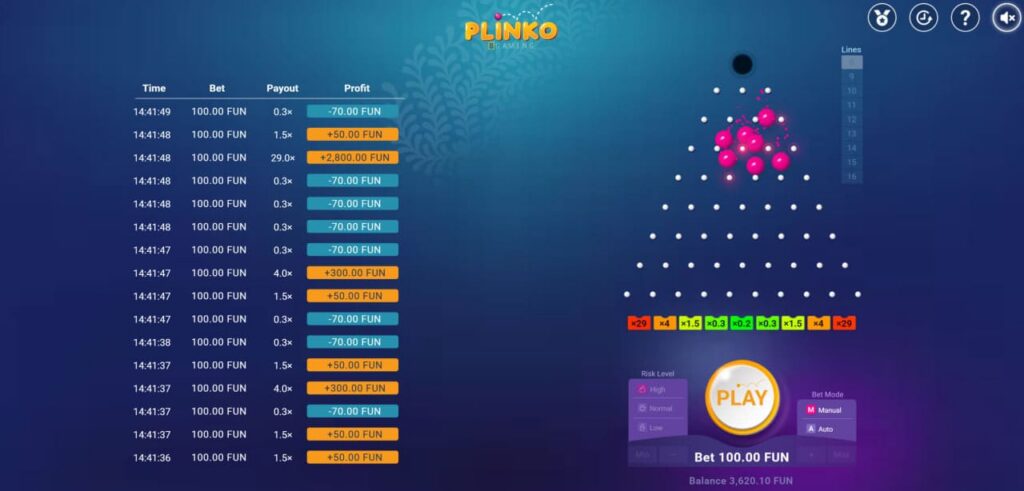
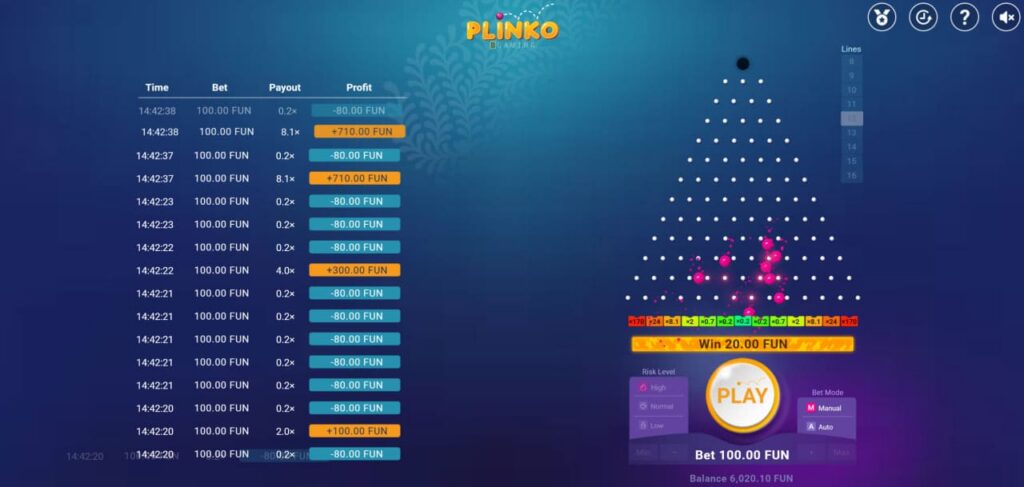
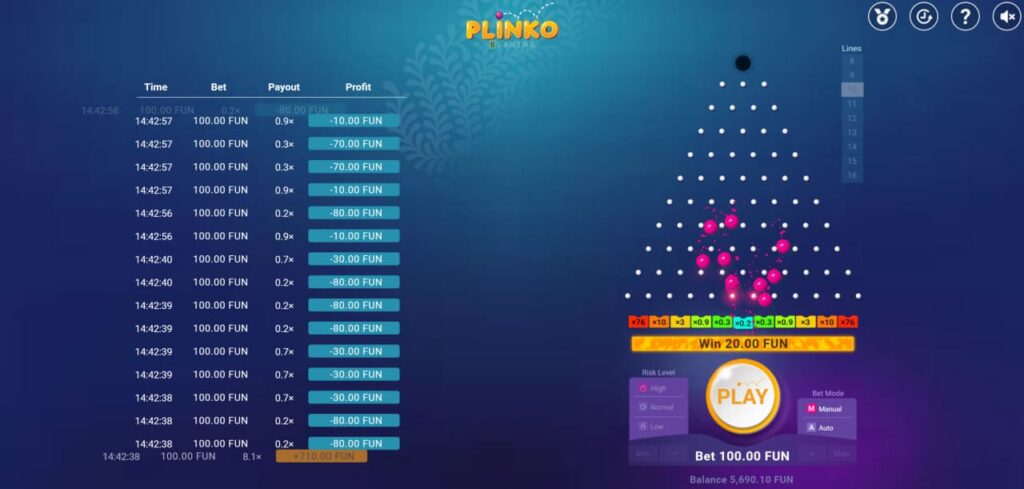
The most important number in High risk Plinko gambling game is not the 1000x maximum multiplier — it is the 0.2x center-slot multiplier. At High risk / 16 rows, the center slot is the most frequently hit position on the board. Every time the chip lands there, you receive 20% of your stake back.
This creates a specific bankroll drain pattern: frequent small losses punctuated by rare large wins. The 99% RTP is accurate over a very large number of drops, but in a short session (20–50 drops), the center-slot drain can consume 60–80% of your session budget before a high-multiplier hit occurs.
At 16 rows, the center slot is hit approximately 12.5% of the time; at 8 rows, approximately 27% of the time. At High risk, both center slots pay below stake — meaning a 16-row High risk session produces a below-stake result roughly 1 in 8 drops from the center alone.
Practical rule: At High risk, your per-drop stake should not exceed 1–2% of your total session bankroll. A $500 session budget supports $5–$10 per drop. A $50 session budget supports $0.50–$1 per drop. Exceeding this ratio significantly increases the probability of bankroll depletion before the RTP normalizes.
What Happens When You Play High Risk: A Session Breakdown
High risk / 16 rows is the most popular configuration among experienced players — and the most misunderstood. Here is what a typical 20-drop session actually looks like, based on the published multiplier structure.
At High risk / 16 rows, the center slot pays 0.2x your stake. The center slot is also the most frequently hit position on the board. In a 20-drop session at $10 per drop ($200 total wagered), a player hitting the center slot 14 times receives $28 from those drops — a loss of $112 before any edge-slot hits are counted.
The session’s profitability depends entirely on whether an edge-slot hit (1000x) occurs within the session window. At 16 rows, the probability of hitting the outermost edge slot on any single drop is approximately 0.003% — meaning edge hits are rare events that require large sample sizes to normalize toward the published 99% RTP.
The practical implication: High risk / 16 rows is a configuration designed for players with a large session bankroll relative to their per-drop stake. A $10 per-drop player needs a session budget of at least $500–$1,000 to give the RTP time to normalize. Players with a $50 session budget should use Low or Medium risk to avoid bankroll depletion before a high-multiplier hit occurs.
Plinko Strategy: Configuration Choices, Betting Systems, and Session Management
The game is fundamentally luck-based, but informed decisions about configuration and bankroll management can extend your sessions and improve your overall experience. The following strategies are commonly used by experienced players, each suited to a different risk tolerance.
- Martingale: double your bet after each loss to recover previous losses on the next win. Requires a substantial bankroll and carries significant risk of hitting session limits. At High risk, variance exceeds the doubling capacity of most bankrolls within 10–15 drops — making Martingale particularly dangerous at this setting.
- Anti-Martingale: increase your stake after wins to capitalize on hot streaks, then return to your base bet after a loss.
- Flat Betting: use a fixed stake on every drop. This is the most conservative approach and the most effective for long-session bankroll preservation.
No strategy eliminates the house edge. The most reliable approach is to set a session budget before you start and stop when you reach it — win or lose. Never chase losses — the house edge is fixed at approximately 1%, and no betting system can overcome it over a long session.
The following principles apply specifically to real-money sessions:
- Play at verified casinos: confirm the platform’s license status before depositing. Curaçao eGaming and MGA licenses are publicly verifiable through each regulator’s official registry.
- Set limits before you play: decide on a maximum loss amount for the session before you start.
- Understand the payout structure: at High risk with 16 rows, the edge slots pay up to 1000x but the center slots pay less than your stake. Know the full multiplier range for your chosen configuration before committing to a session.
- Prioritize entertainment: approach the game as a form of entertainment with a defined cost, not as an income source.
Use demo mode to test a specific combination of row count, risk tier, and bet size over at least 100 rounds before applying the approach in real-money play. Player forums and streamer content provide real-world examples of how different configurations perform over extended play — observing experienced players can accelerate your understanding of variance and session management.
Understand the Game’s Core Mechanics
A deeper understanding of the mechanics helps players make more informed configuration choices. The following points explain the key technical elements that drive every round.
- Ball Drop Physics: the chip’s path through the peg grid is determined by the RNG at each peg contact point. The visual animation reflects the calculated outcome — the path is not physically simulated in real time but is rendered to match the pre-calculated result.
- Autobet Mode: most implementations include an autobet feature that allows players to set a number of automatic drops, a stop-loss limit, and a stop-win target. This is useful for executing a flat-betting strategy consistently over many rounds without manual input.
- Payout Frequency: at Low risk, the center slots are hit most frequently, producing small but consistent returns. At High risk, center slots are also hit most frequently but pay less than the stake — the rare edge-slot hits are what drive the session’s overall return toward the published RTP.
Autobet Configuration: Stop-Loss, Stop-Win, and Round Count
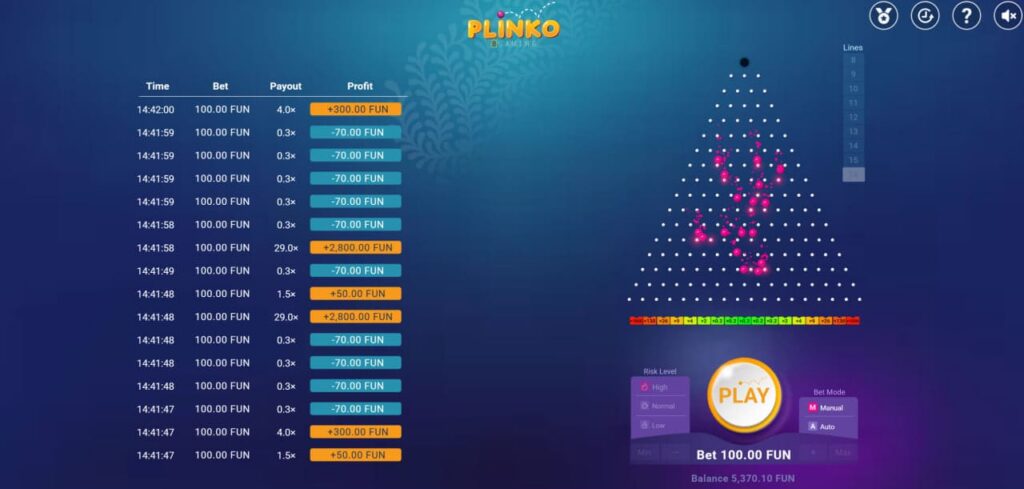
The autobet feature is the most powerful tool in the game — and the most dangerous if misconfigured. Most implementations allow you to set three parameters: the number of automatic drops, a stop-loss threshold (stop if balance drops by X), and a stop-win threshold (stop if balance increases by X).
Recommended autobet configuration for High risk / 16 rows:
- Round count: 50–100 drops (enough for the RTP to begin normalizing)
- Stop-loss: 30% of session bankroll (prevents a single unlucky streak from ending the session)
- Stop-win: 200% of session bankroll (locks in a significant win before variance reverses)
Recommended autobet configuration for Low risk / 16 rows:
- Round count: 200–500 drops (Low risk requires more drops to demonstrate its distribution)
- Stop-loss: 15% of session bankroll (Low risk variance is lower; tighter stop-loss is appropriate)
- Stop-win: 50% of session bankroll (Low risk wins are smaller; a 50% gain is a strong session result)
A practical stop-loss formula for autobet sessions: set your stop-loss at 20–30% of your session bankroll. At High risk / 16 rows, the expected center-slot hit rate is approximately 65–70% of drops — meaning a 30-drop autobet session will produce roughly 20 below-stake results before a high-multiplier hit. A stop-loss of 30% of bankroll prevents a single unlucky streak from ending the session before the RTP can normalize.
Never run autobet without a stop-loss configured. An uncapped autobet session at High risk can deplete a session bankroll in minutes if the chip consistently hits center slots.
Diagnostic: Which slot Configuration Matches Your Session Profile?
Before committing to a configuration, answer the following questions to identify the setup that matches your risk tolerance and session budget. Each answer maps directly to a specific row count and risk tier combination.
Question 1: What is your session bankroll relative to your per-drop stake?
- Less than 20x your intended stake → Use Low risk / 8 rows (tightest distribution, most consistent returns)
- 20–50x your intended stake → Use Medium risk / 12 rows (balanced variance, achievable edge hits)
- 50x or more your intended stake → High risk / 16 rows is viable (sufficient bankroll depth for RTP normalization)
Question 2: What is your primary session goal?
- Extend play time and minimize loss rate → Low risk / 8 rows (center slot pays 1x; you lose slowly)
- Balance entertainment with win potential → Medium risk / 12 rows (edge hits at 43x–130x are achievable)
- Chase a single large multiplier → High risk / 16 rows (1000x possible; accept frequent below-stake results)
Question 3: Are you using a bonus with wagering requirements?
- Yes → Use Low risk (consistent returns help clear wagering requirements without large swings)
- No → Any risk tier is appropriate based on your bankroll depth
Question 4: Are you using autobet?
- Yes → Always configure a stop-loss at 20–30% of session bankroll before starting
- No → Manual play allows real-time adjustment; start conservative and increase risk only after observing the distribution
Red flags — stop and reconfigure if:
- You are playing High risk with a session bankroll less than 30x your per-drop stake
- You are running autobet without a stop-loss
- You are using Martingale at High risk (variance exceeds the doubling capacity of most bankrolls within 10–15 drops)
- You have claimed a bonus without verifying the slot’s wagering contribution rate on that platform
Provably Fair Technology Explained
The term “provably fair” appears frequently in plinko casino contexts, but the mechanism behind it is rarely explained. Here is how the verification system works.
Before each drop, the casino generates a server seed — a random string kept secret until after the round — and shares a hashed version with the player. The player also provides a client seed, a string they can set themselves. A nonce (a sequential counter) is added to ensure each round produces a unique result even when the same seeds are reused.
The outcome is calculated by combining these three inputs through a cryptographic hash function. After the round, the server reveals the original server seed. The player can independently verify that the result matches the hash they received before the drop, confirming the casino could not have manipulated the outcome.
BGaming and Spribe both implement this system. Independent testing laboratories including eCOGRA and iTech Labs certify the RNG implementations used by licensed developers, providing an additional layer of third-party verification beyond the provably fair mechanism itself.
Platform Comparison: Where to Play Online
Not all platforms that offer this slot are equivalent. The following table compares the five most widely recommended platforms across the dimensions that matter most for real-money play.
| Platform | License | Min Deposit | Withdrawal Speed | Bonus Contribution | Provably Fair |
|---|---|---|---|---|---|
| Stake | Curaçao eGaming | $10 (crypto) | Minutes (crypto) | Check terms | Yes (BGaming) |
| Roobet | Curaçao eGaming | $10 (crypto) | Minutes (crypto) | Check terms | Yes (BGaming) |
| BC.Game | Curaçao eGaming | $1 (crypto) | Minutes (crypto) | Check terms | Yes (multi-provider) |
| TrustDice | Curaçao eGaming | $5 (crypto) | Minutes (crypto) | Check terms | Yes (BGaming) |
| Rollbit | Curaçao eGaming | $5 (crypto) | Minutes (crypto) | Check terms | Yes (BGaming) |
Important: Wagering contribution rates for the game vary by platform and bonus type. Before claiming any welcome offer or deposit match, verify in the bonus terms whether the slot counts at 100%, 50%, or 0% toward the wagering requirement. A bonus that excludes this slot from wagering contributions is effectively unusable for this game.
Curaçao eGaming vs. MGA: What the License Difference Means for You
Both Curaçao eGaming and the Malta Gaming Authority (MGA) are mentioned on most platform pages, but the practical difference for players is rarely explained.
Curaçao eGaming is the more permissive license. It is faster and cheaper to obtain, which is why most crypto-native platforms (Stake, Roobet, BC.Game) hold it. Curaçao-licensed casinos are subject to fewer player protection requirements: dispute resolution is handled by the operator, player funds are not required to be held in segregated accounts, and self-exclusion enforcement is operator-dependent.
MGA (Malta Gaming Authority) is the stricter license. MGA-licensed operators must hold player funds in segregated accounts, participate in a formal dispute resolution process (the MGA’s Player Support Unit), and enforce self-exclusion across all MGA-licensed platforms. Withdrawal disputes at MGA-licensed casinos have a formal escalation path that Curaçao-licensed casinos do not provide.
Practical implication: for large-balance players or those who anticipate disputes, an MGA-licensed platform offers meaningfully stronger protection. For crypto-native players who prioritize speed and anonymity, Curaçao-licensed platforms are the standard option. Always verify the license number against the regulator’s public registry before depositing.
Start Playing Plinko Casino – Quick and Easy Setup
Choosing the right platform is the most important decision before your first real-money session. Reputable platforms hold licenses from recognized authorities — look for casinos regulated by Curaçao eGaming or the Malta Gaming Authority (MGA), the two most common licensing bodies for platforms offering this game. A valid license means the operator is subject to regulatory oversight and player fund protection requirements.
The following steps cover the full setup process from platform selection to your first drop:
- Choose a Licensed Casino: verify the platform holds a valid license from Curaçao eGaming, MGA, or another recognized authority. Check the license number against the regulator’s public registry.
- Complete KYC Verification: most platforms require Know Your Customer (KYC) identity verification before processing withdrawals. Prepare a government-issued ID and proof of address. This process protects both the player and the operator from fraud.
- Select a Game Mode: start with demo play to familiarize yourself with the row and risk settings before committing real funds.
- Fund Your Account: deposit using your preferred method — fiat currencies, Bitcoin, Ethereum, or other supported cryptocurrencies.
- Customize Your Session: set your row count, risk tier, and bet size before your first drop.
- Press Play: launch the game and begin with conservative settings until you are comfortable with the mechanics.
Wagering Requirements by Platform: Which Casinos Count Plinko at 100%
Wagering requirements are one of the most consequential — and least understood — aspects of playing plinko casino with a bonus. The requirement specifies how many times you must play through a bonus amount before it becomes withdrawable. A $100 bonus with a 30x wagering requirement means you must wager $3,000 before the funds become withdrawable.
The critical variable for players is the wagering contribution rate: the percentage of each bet that counts toward clearing the requirement. The following scenarios illustrate why this matters:
- If it counts at 100%: every $1 wagered on the slot clears $1 of the wagering requirement. A $3,000 requirement can be cleared entirely through play.
- If the slot counts at 50%: every $1 wagered on the game clears $0.50 of the requirement. You must wager $6,000 on the slot to clear a $3,000 requirement.
- If it counts at 0%: the slot play does not contribute to the wagering requirement at all. The bonus cannot be cleared through the slot.
Before claiming any welcome offer or deposit match, locate the bonus terms and find the game contribution table. If it is excluded or reduced, either choose a different bonus or use Low risk to minimize variance while clearing the requirement through other games. Welcome offers, cashback deals, and loyalty rewards can extend your bankroll — but only if the wagering requirements are achievable within your session budget.
Plinko Slot – The Classic Reimagined
The slot-style presentation of the chip-drop mechanic adds visual polish and additional features to the core game. Developers have built distinct versions with different interfaces, multiplier structures, and bonus mechanics, each offering a slightly different experience while preserving the fundamental drop-and-land format.
Each round delivers a fresh experience thanks to the RNG-driven outcome system and the visual spectacle of the chip’s path through the peg grid.
Slot Developers You Can Trust
Several developers have produced notable versions of the game. The following are the two most widely distributed, each with a distinct approach to fairness and design.
- BGaming: the most prominent developer, responsible for the version with 99% RTP and the 8/12/16 row configuration system. BGaming’s implementation is certified by independent testing labs and is available at hundreds of licensed casinos globally.
- Spribe: known for its provably fair architecture and crypto-native design, Spribe’s version is popular at blockchain-based casinos. The seed verification interface is built directly into the game UI, making it easy for players to verify any round.
Other developers including Hacksaw Gaming and Turbo Games have produced Plinko-style variants with different visual styles and mechanics.
Plinko Variants: XY, 1000x, and More
Beyond the standard implementation, several variants have developed their own player bases. The following are the most notable:
- XY: a variant developed by Turbo Games that introduces a two-axis drop mechanic, adding a horizontal element to the standard vertical drop and giving players an additional configuration choice. See the dedicated comparison section below for a full breakdown of how the two-axis mechanic affects probability.
- 1000x: a high-volatility variant specifically designed around the maximum multiplier, with a board configuration optimized for extreme outcomes and a player base that favors high-risk sessions.
These variants are available on dedicated pages and offer distinct experiences for players who have mastered the standard format.
Plinko XY vs. Standard: How the Two-Axis Mechanic Changes Your Odds
Standard Plinko gambling game uses a single-axis drop: the chip falls vertically from a fixed starting position at the top of the board. XY, developed by Turbo slots, introduces a horizontal starting position that the player can adjust before each drop.
The practical effect of the horizontal starting position is significant. In standard, the chip’s starting position is fixed at the center of the board — meaning the probability distribution is symmetric, and edge-slot hits require the chip to drift consistently in one direction through all 16 rows. In XY, starting the chip closer to the left or right edge of the board increases the probability of landing in the high-multiplier slots on that side, but reduces the probability of reaching the opposite edge’s high-multiplier slots.
Key difference: XY gives players the illusion of additional control, but the underlying RNG still determines the outcome at each peg contact point. The horizontal starting position shifts the probability distribution — it does not override it. Players who start at the far left edge will hit left-side high-multiplier slots more frequently, but the overall expected return (RTP) remains the same as standard.
When to choose XY: if you prefer a more interactive experience and want to concentrate your variance on one side of the board, XY offers a meaningful configuration difference. If you prefer the symmetric distribution of standard, the BGaming implementation remains the more widely available option.
Try Plinko for Free – The Power of Demo Mode
Most major platforms offer a demo version that uses virtual credits instead of real money. This mode is functionally identical to the real-money version — the same row configurations, risk tiers, and multiplier values apply. The only difference is that winnings cannot be withdrawn.
Demo mode is the most effective way to understand how the board configuration and risk settings interact before committing real funds. It is also useful for experienced players who want to test a new strategy without financial exposure.
The following practices maximize the value of demo sessions. Each point addresses a specific learning objective that translates directly to better real-money decision-making.
- Explore All Row Configurations: test 8, 12, and 16 rows at each risk tier to understand how the distribution changes. Note which configurations produce the outcome patterns that match your risk tolerance.
- Experiment with Betting Systems: try Martingale, Anti-Martingale, and flat betting across multiple sessions to identify which approach suits your style and bankroll.
- Test the Autobet Feature: use the automated drop function to observe outcome distributions over a large number of rounds without manual input. This gives a clearer picture of the game’s variance than a small manual sample.
Demo mode is not just for beginners. Experienced players use it regularly to validate new approaches before applying them in real-money sessions.
Crypto Plinko – Play Anonymously, Win Instantly
Cryptocurrency has become the dominant payment method at focused platforms. Bitcoin, Ethereum, and Litecoin are accepted at most major crypto casinos, with deposits and withdrawals processed in minutes rather than days.
The crypto casino ecosystem has also developed competitive formats around the game. Platforms like Rollbit and BC.Game run the game tournaments and leaderboard competitions, where players compete for prize pools based on their session performance. These events add a social and competitive dimension that is absent from standard play.
BC.Game allows up to 10 simultaneous drops. At $1 per ball with 10 balls active, your effective stake per round is $10 — but the variance compounds: you are running 10 independent RNG events simultaneously, which means the probability of at least one edge-slot hit per round increases significantly at 16 rows High risk.
The following points summarize the key advantages of crypto-based play:
- Fast, Low-Fee Transactions: crypto deposits and withdrawals are processed on-chain, typically within minutes and with minimal fees compared to traditional banking methods.
- Provably Fair Verification: blockchain-based casinos publish the hash of each round’s server seed before the drop, allowing independent verification of every outcome.
- Anonymous Play: many crypto platforms allow play with minimal personal information, though KYC may still be required for large withdrawals depending on the platform’s licensing requirements.
- Bonus-Loaded Experience: crypto casinos frequently offer larger welcome bonuses, exclusive tournament entries, and loyalty rewards for regular players.
Platforms including TrustDice and BC.Game specialize in provably fair crypto play and offer the full range of row and risk configurations alongside autobet functionality. Always verify a platform’s license status before depositing, regardless of whether you are using fiat or cryptocurrency.
Play Smart: Responsible Plinko Gambling
Responsible play is not optional — it is the foundation of a sustainable gambling experience. Set clear limits on both time and money before each session. Treat the game as entertainment with a defined cost, not as a method of generating income.
If gambling stops being enjoyable, stop playing. This is the single most important principle for any player, regardless of experience level or session budget.
For players who need support, the following organizations provide free, confidential resources:
- GamCare (gamcare.org.uk) — offers counseling, a helpline, and self-exclusion tools for players in the UK and internationally.
- BeGambleAware (begambleaware.org) — provides information, advice, and referral services for anyone affected by gambling-related harm.
Both organizations offer self-exclusion programs that allow players to block access to gambling platforms for a defined period. Most licensed casinos — including those regulated by Curaçao eGaming and MGA — are required to support these tools as a condition of their license.
Frequently Asked Questions
The 99% RTP is a long-run average calculated over millions of drops. In a 20–50 drop session, the actual return can deviate significantly from 99% in either direction. At High risk / 16 rows, a session without an edge-slot hit will return approximately 20–30% of your wagered amount (from center-slot hits at 0.2x). The RTP normalizes over thousands of drops — not over a single session. If you are playing short sessions at High risk, you are operating in the high-variance zone where the published RTP is statistically irrelevant.

John Rock is a sports analyst from Lima, known for his sharp insights and accurate predictions in football matches. With over 5 years of experience in the sports analysis and online gaming industry, he has made a name for himself by contributing detailed forecasts and unique perspectives to various sports publications, earning him a respected reputation in the field.